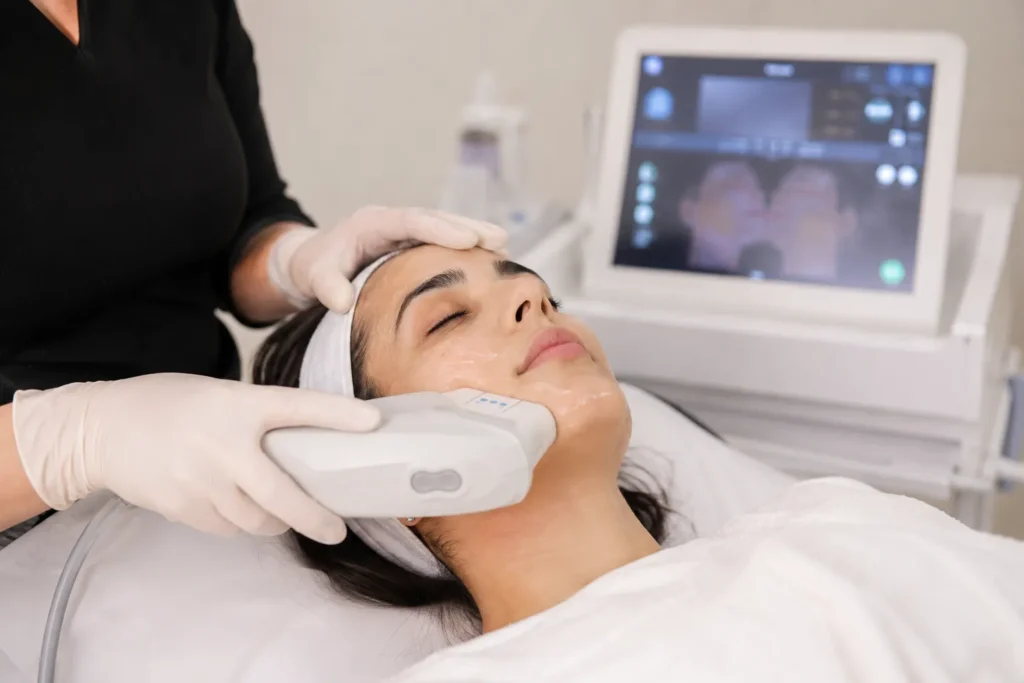
Loose skin around the jawline, mild jowls, fine lines and loss of facial firmness can change how your face looks. Many people want a tighter, fresher appearance without surgery or lengthy downtime.
HIFU Facial Treatment in Andheri West is one option people consider for non-invasive skin tightening. It uses focused ultrasound energy to create controlled effects beneath the skin. The aim is to improve the appearance of lax skin and support a firmer-looking facial contour.
But HIFU isn’t suitable for everyone, and results depend on factors such as age, skin laxity, facial structure and the device used.
This guide explains how HIFU works, what results you can realistically expect, how treatment is performed, possible side effects, cost factors and questions worth asking before booking.
What Is HIFU Facial Treatment?
HIFU stands for High-Intensity Focused Ultrasound.
In aesthetic treatments, focused ultrasound energy can be delivered at selected depths beneath the skin. The energy creates controlled thermal effects in targeted tissue while the surface of the skin is not treated in the same way as an ablative laser.
Certain aesthetic focused-ultrasound systems are designed to produce localized heating below the skin, which can contribute to tissue contraction and an improvement in the appearance of skin laxity. The FDA classifies focused ultrasound systems for aesthetic use under a specific medical-device category.
That is why you may hear HIFU described using terms such as:
- Non-surgical skin tightening
- Ultrasound skin tightening
- HIFU facelift
- Non-invasive facelift
- Facial contouring
- Jawline tightening
- Skin lifting treatment
- Ultrasound facial tightening
These terms don’t mean that HIFU replaces a surgical facelift. The expected effect is generally more subtle and depends on the amount of skin laxity and the treatment system being used.
How Does HIFU Work for Skin Tightening?
The basic idea is straightforward.
The device delivers focused ultrasound energy into selected tissue depths. Depending on the device and treatment protocol, this energy creates controlled thermal points beneath the skin.
This controlled response can encourage tissue contraction and changes associated with collagen remodeling.
A useful way to understand it is to imagine fabric that has become slightly loose. Heating and treating selected areas can create a tightening effect. Skin biology is more complex than fabric, of course, but the comparison helps explain why the visible improvement isn’t always immediate.
Some modern focused-ultrasound systems also use imaging to help visualize tissue depth and guide energy delivery. For example, FDA documentation for the Ulthera system describes imaging that can help visualize tissue layers and support appropriate treatment depth.
Does HIFU remove facial fat?
This is an important question.
Facial HIFU for skin tightening should not automatically be considered a fat-reduction treatment. Different ultrasound devices have different indications, energy levels and treatment purposes.
Some HIFU technologies are designed for other aesthetic applications involving subcutaneous tissue. Therefore, the exact device and its intended use matter.
For facial treatment, excessive energy or inappropriate treatment planning isn’t something to take lightly. Facial anatomy varies considerably from person to person.
That is why treatment should be planned according to your facial structure rather than simply following a standard number of shots.
What Skin Concerns Can HIFU Address?
People commonly consider ultrasound skin tightening when they notice mild to moderate skin laxity.
Depending on the device and clinical assessment, treatment may be considered for areas such as:
Jawline laxity
A softer jawline can develop with age as skin elasticity changes. HIFU may help create a firmer-looking contour in suitable patients.
Mild jowling
Small areas of lax tissue around the lower face can make the jawline appear less defined.
Loose skin under the chin
Some people seek non-invasive options when they notice mild laxity beneath the chin.
Neck skin laxity
The neck is another area where skin firmness can change with age.
Fine lines and wrinkles
Focused ultrasound may improve the appearance of certain lines associated with skin laxity, depending on the treatment system and indication.
Loss of facial firmness
If your skin feels less firm than it used to, a skin-tightening consultation can help determine whether HIFU is appropriate.
It is important to separate skin tightening from treatments designed specifically for pigmentation, active acne, acne scars or significant volume loss. One procedure rarely addresses every skin concern.
Who Is a Good Candidate for HIFU?
HIFU may be worth discussing if you have:
- Mild to moderate skin laxity
- Early jowling
- A less defined jawline
- Mild neck laxity
- Early signs of ageing
- Fine lines associated with laxity
- A preference for non-surgical treatment
- Little interest in significant downtime
A consultation is particularly useful when you’re unsure whether your problem is loose skin, facial volume loss, pigmentation or something else.
For example, someone may say, “My face looks older because my cheeks are dropping.”
But the actual issue could involve skin laxity, loss of facial volume, changes in facial fat distribution or a combination of these.
The right treatment depends on the cause.
HIFU Facial Treatment: Step-by-Step
Wondering what happens during a HIFU facial?
Here’s a typical treatment pathway.
1. Skin and facial assessment
The practitioner examines the areas of concern and looks at skin laxity, facial proportions and treatment goals.
2. Treatment planning
The treatment area is marked or mapped according to the selected protocol.
Different parts of the face may require different depths or treatment approaches.
3. Skin preparation
The skin is cleaned before treatment. A suitable coupling medium may be applied according to the device protocol.
4. Ultrasound energy delivery
The handpiece is placed against the skin and controlled ultrasound energy is delivered to the planned areas.
You may feel warmth, tingling or brief pulses during this stage.
5. Area-by-area treatment
The jawline, lower face, cheeks, chin or neck may be treated according to the individual plan.
6. Post-treatment review
The skin is checked after treatment and aftercare advice is provided.
The exact steps vary by device, treatment area and clinic protocol.
What Does HIFU Feel Like?
This is one of the most searched questions before treatment.
There isn’t one sensation that everyone experiences.
Some people describe HIFU as:
- Warmth
- Tingling
- Short pulses
- A mild prickling sensation
- Brief discomfort in sensitive areas
Sensitivity can vary around the jawline and bony areas.
A good consultation should include a discussion about comfort and what you can expect during treatment. Don’t judge treatment quality by how painful it feels. More discomfort doesn’t automatically mean better results.
Benefits of HIFU Facial Treatment
The main reason people choose HIFU is the possibility of improving skin firmness without surgery.
Potential benefits include:
Non-surgical approach: HIFU does not require surgical incisions.
Little or no traditional downtime: Many people can return to normal activities relatively quickly, although temporary redness, swelling or tenderness can occur.
Skin tightening: Treatment may improve the appearance of mild skin laxity.
Jawline definition: Selected patients may notice a more defined-looking lower face.
Neck tightening: Some suitable patients seek treatment for mild neck laxity.
Gradual-looking improvement: Changes can develop over time rather than appearing like an overnight transformation.
Targeted treatment: Focused ultrasound can be delivered to selected tissue depths.
However, the result isn’t guaranteed to be dramatic. The FDA notes that aesthetic focused-ultrasound devices are intended for temporary changes in physical appearance, and device-specific indications matter.
HIFU Results: When Can You See a Difference?
One common mistake is expecting a completely different face immediately after treatment.
HIFU results can develop gradually.
Some people notice an early change in tightness or contour, while the more meaningful improvement may become clearer over the following weeks or months as tissue remodeling progresses.
Your result depends on:
- Age
- Skin quality
- Degree of laxity
- Facial anatomy
- Treatment area
- Device used
- Energy settings
- Treatment technique
- Your body’s response
A younger person with mild laxity may need a different approach from someone with significant ageing-related skin changes.
How Long Do HIFU Results Last?
There isn’t one guaranteed duration for everyone.
Results can vary based on the treatment system, skin condition, ageing process and lifestyle.
Remember that HIFU doesn’t stop natural ageing. Your skin continues to change after treatment.
Sun exposure, smoking, weight changes and general skin health can also influence how your skin looks over time.
Instead of asking only, “How long will it last?”, ask:
“What type of improvement is realistic for my skin, and when should I reassess it?”
That’s a more useful way to approach a skin-tightening treatment.
HIFU vs Other Skin-Tightening Treatments
People often compare HIFU with RF, laser treatments and surgical facelifts.
The right comparison depends on the actual concern.
| Treatment | Main Focus | Downtime | Best For |
|---|---|---|---|
| HIFU | Focused ultrasound-based tightening | Usually limited | Selected cases of skin laxity |
| RF skin tightening | Radiofrequency-based heating | Usually limited | Skin firmness and texture |
| Laser treatments | Skin resurfacing or specific concerns | Device-dependent | Texture, pigmentation, lines and other indications |
| Surgical facelift | Surgical repositioning of tissue | Significant | More advanced facial ageing |
HIFU isn’t necessarily “better” than every other treatment.
For someone with mild laxity, a non-invasive option may make sense. For significant sagging, a surgical consultation may be more appropriate.
A good clinic should explain both possibilities rather than promising that one treatment can solve every ageing concern.
HIFU Facial Treatment Cost in Andheri West
The HIFU facial treatment cost in Andheri West can vary considerably.
There isn’t a responsible single price that applies to every patient.
Cost may depend on:
- Treatment area
- Number of lines or pulses
- Device and transducer used
- Technology available at the clinic
- Facial and neck areas included
- Treatment plan
- Experience of the treating professional
- Whether additional treatments are recommended
For example, treating only the lower face is different from treating the face, jawline and neck.
Before comparing prices, ask what is included. A cheaper quote may not represent the same treatment area, technology or treatment plan.
Is HIFU Safe?
Focused ultrasound devices used for aesthetic purposes are medical devices with specific safety considerations.
The FDA’s guidance identifies risks associated with focused-ultrasound aesthetic systems and emphasizes appropriate device controls and risk management.
Possible temporary effects can include:
- Redness
- Swelling
- Tenderness
- Tingling
- Sensitivity
- Temporary discomfort
Rare or device-specific complications can also occur.
That is why HIFU shouldn’t be treated like a casual beauty facial.
Device selection, treatment depth, energy settings and knowledge of facial anatomy all matter.
If you have persistent pain, unusual swelling, burns, weakness, numbness or another concerning symptom after treatment, seek medical advice promptly.
Who Should Avoid HIFU?
Suitability should be decided during a proper consultation.
You may need to postpone or avoid treatment depending on factors such as:
- Active infection in the treatment area
- Open wounds
- Certain implanted devices or materials
- Certain medical conditions
- Pregnancy or other circumstances where treatment isn’t advised
- Significant skin inflammation
- Very thin or unsuitable tissue in the proposed treatment area
The exact contraindications depend on the device being used.
This is another reason not to assume that every HIFU machine has identical indications or safety instructions.
HIFU Aftercare
After treatment, follow the clinic’s specific instructions.
General advice may include:
- Keep your skincare routine gentle initially.
- Avoid unnecessary irritation.
- Use broad-spectrum sunscreen.
- Don’t aggressively massage treated areas unless advised.
- Follow instructions about exercise, heat and active skincare products.
- Contact the clinic if you develop an unusual reaction.
Sunscreen remains important regardless of whether you have undergone HIFU.
Good skin care won’t replace a treatment, but it can help support the overall appearance and health of your skin.
Common Mistakes to Avoid Before HIFU
Choosing a clinic only because it is cheap
Price matters, but it shouldn’t be your only filter.
Ask about the technology, treatment plan, professional performing the procedure and follow-up.
Expecting a surgical facelift result
HIFU is non-surgical. Expecting surgical-level lifting can lead to disappointment.
Asking for the maximum possible energy
More energy isn’t automatically better.
Treatment should be based on anatomy, device instructions and clinical judgement.
Ignoring facial volume
If your face has lost volume, tightening the skin alone may not create the appearance you want.
Treating every skin problem with HIFU
HIFU isn’t primarily an acne treatment, pigmentation treatment or scar-resurfacing procedure.
Your treatment should match your actual concern.
Real-Life Example: When HIFU May Make Sense
Imagine someone in their early 40s who notices that the jawline isn’t as sharp as it was five years ago.
There is mild laxity around the lower face, but no major sagging. They don’t want surgery and aren’t looking for an overnight transformation.
This person may be a reasonable candidate for a non-surgical tightening consultation.
Now consider someone with significant loose skin and pronounced jowls.
Their expectations and treatment needs are different. HIFU alone may not provide the degree of lifting they want.
That’s why personal assessment is more important than simply choosing the most popular treatment.
HIFU Facial Treatment in Andheri West: Questions to Ask Before Booking
Before starting treatment, ask:
- What HIFU device will be used?
- What is the device intended to treat?
- Who will perform the procedure?
- Which areas will be treated?
- What result is realistic for my skin?
- How many sessions might I need?
- What are the possible side effects?
- What should I avoid after treatment?
- What happens if I don’t respond as expected?
- Is another treatment more suitable for my concern?
These questions can help you make a better decision than simply searching for the cheapest package.
Expert Tips Before Your HIFU Treatment
If you’re considering HIFU Facial Treatment in Andheri West, don’t start with the price.
Start with the problem you want to solve.
Is it:
- Loose skin?
- A soft jawline?
- Neck laxity?
- Fine lines?
- Loss of firmness?
- Facial volume loss?
- Pigmentation?
- Acne?
- Acne scars?
These concerns can look similar in a mirror but require different approaches.
A proper consultation should also include an honest discussion about what HIFU cannot do.
That is often more valuable than a promise of dramatic results.
Dr Vritika Agrawal is a dynamic Entrepreneur, investor and the Founder and CEO of DERMACUTE AESTHETICS SKIN CLINIC.
Is HIFU Right for You?
HIFU can be an interesting option for people who want to improve the appearance of mild to moderate skin laxity without surgery.
It may help create a firmer-looking jawline, improve selected areas of facial or neck laxity and support a more refreshed appearance. But it isn’t a magic facelift, and it isn’t the right solution for every skin concern.
The best starting point is a professional assessment.
If you’re considering HIFU Facial Treatment in Andheri West, focus on your skin condition, treatment goals, the technology being used and the expected outcome rather than choosing a treatment based only on price.
And if your main concern is acne rather than loose skin, HIFU may not be the appropriate first choice.
Looking for Acne Treatment?
If you’re dealing with active acne, recurring breakouts, acne marks or clogged pores, your skin needs a different treatment strategy.
DERMACUTE AESTHETICS SKIN CLINIC can assess your skin concern and help determine which Acne Treatment approach is appropriate for you.
If you’re searching for the Best Skin Care Clinic in Andheri, start with a proper consultation rather than selecting a procedure based on an online trend.
Book a consultation with DERMACUTE AESTHETICS SKIN CLINIC to discuss your skin concerns and explore suitable treatment options.
FAQs
1. Is HIFU the same as a facelift?
No. HIFU is a non-invasive aesthetic treatment, while a facelift is surgery.
HIFU may improve the appearance of selected cases of skin laxity, but it doesn’t surgically reposition facial tissues.
2. Is HIFU painful?
People experience it differently. Some feel warmth, tingling or brief pulses. Sensitive areas may feel more uncomfortable.
3. Does HIFU permanently tighten skin?
No cosmetic treatment should be described as permanently stopping ageing. HIFU results can change as the skin continues to age.
4. How quickly does HIFU work?
Some changes may be noticed earlier, but improvements can develop gradually. The timeline depends on the individual and the treatment system.
5. Can HIFU remove wrinkles?
HIFU may improve the appearance of some lines and wrinkles associated with laxity. It isn’t a universal wrinkle treatment.
6. Can HIFU reduce double chin?
HIFU is sometimes discussed for the lower face and submental region, but the exact effect depends on the device and the reason for fullness under the chin.
A double chin can involve fat, skin laxity, anatomy or a combination.
7. Can HIFU make the face thinner?
It shouldn’t be assumed that facial HIFU is a fat-reduction procedure.
If facial volume is already low, inappropriate treatment may not produce the desired appearance. Treatment planning should account for facial structure.
8. Is there downtime after HIFU?
Many aesthetic focused-ultrasound treatments are designed to have limited downtime. However, temporary redness, swelling, tenderness or sensitivity may occur.
9. How many HIFU sessions are needed?
There is no universal number. It depends on the device, treatment goal, degree of laxity and individual response.
10. Can I combine HIFU with other treatments?
Sometimes treatments can be combined, but timing matters.
A professional should first assess your skin, existing treatments and treatment goals before recommending a combination.