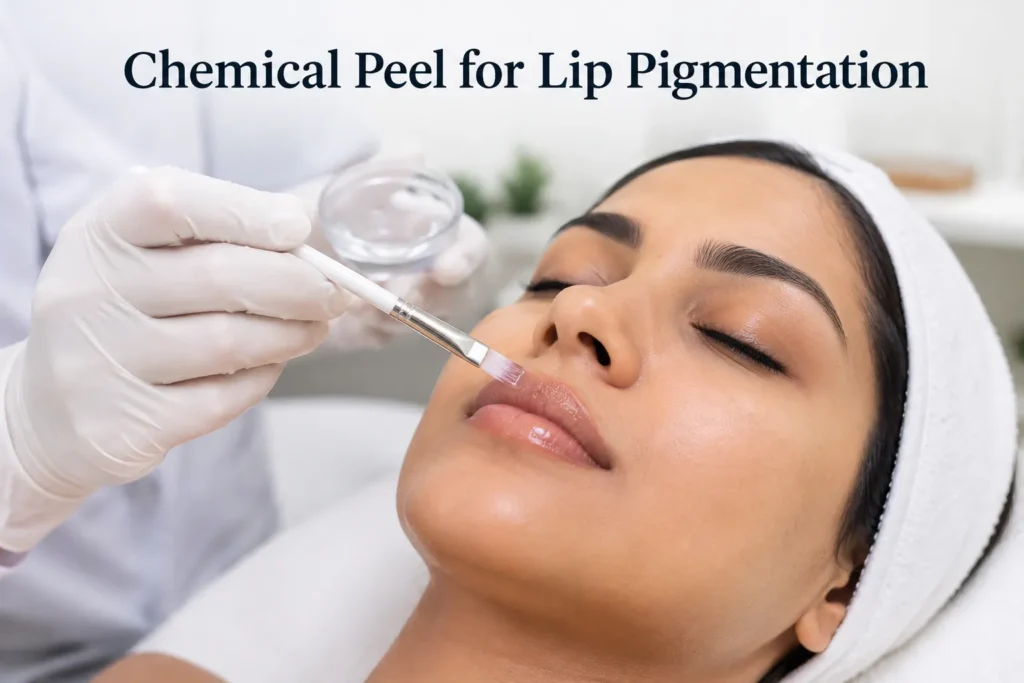
Dark or uneven lips can be frustrating, especially when lip pigmentation becomes more noticeable over time. You may have tried lip balms, scrubs, home remedies, or brightening products without seeing much change. This is where Chemical Peel for Lip Pigmentation may be considered as a professional treatment option.
A chemical peel treatment uses a carefully selected solution to improve the appearance of pigmented skin. But the lips are delicate, so treatment needs a different level of care than a regular facial peel.
If you’re considering a peel for dark lips, the important questions are simple: Does it work? Is it safe? How many sessions are needed? What causes lip pigmentation in the first place? And can the pigmentation come back?
This guide explains the treatment, possible benefits, limitations, preparation, aftercare, and other options you may discuss with a qualified skin professional.
What Causes Dark or Pigmented Lips?
Before choosing a treatment, it’s important to understand why your lips became darker.
Lip pigmentation can have several causes. In some people, it develops gradually. In others, the change may appear after irritation, dryness, inflammation, or repeated exposure to certain triggers.
Common causes include:
- Sun exposure
- Lip licking or frequent rubbing
- Dry or cracked lips
- Smoking or tobacco exposure
- Certain cosmetics or lip products
- Allergic or irritant reactions
- Post-inflammatory pigmentation
- Hormonal changes
- Genetic tendency
- Repeated irritation
- Some medications or medical conditions
Not every case of dark lips is the same.
For example, someone with naturally darker lips may need a different approach from someone whose pigmentation developed after using an irritating lip product.
That is why a proper assessment matters before starting any lip pigmentation treatment.
Why identifying the cause matters
Imagine treating pigmentation while the original trigger continues.
If your lips remain exposed to strong sunlight, become repeatedly irritated, or stay very dry, pigmentation may continue to develop even after treatment.
The goal shouldn’t simply be to make the lips lighter temporarily. It should also involve reducing the factors contributing to pigmentation.
What Is Chemical Peel for Lip Pigmentation?
A chemical peel is a professional skin treatment in which a controlled chemical solution is applied to the targeted area.
For lip pigmentation, a practitioner may select a formulation based on the condition, skin type, pigmentation pattern, sensitivity, and treatment goal.
The solution helps loosen or remove damaged surface cells and can support more even-looking skin over time.
However, Chemical Peel for Lip Pigmentation isn’t the same as using a strong facial peel on the lips.
The lip area is sensitive. The concentration, application method, contact time, and aftercare all need to be carefully controlled.
What is the goal of the treatment?
Depending on the cause and type of pigmentation, a chemical peel may help:
- Improve uneven lip tone
- Reduce the appearance of superficial pigmentation
- Improve dull-looking lips
- Remove accumulated surface cells
- Support smoother lip texture
- Encourage more even-looking skin
Results vary from person to person.
A peel isn’t designed to completely change someone’s natural lip colour. Instead, the aim is generally to improve unwanted or acquired pigmentation while keeping expectations realistic.
Does Chemical Peel Treatment Really Work for Dark Lips?
Yes, a chemical peel treatment can help some types of lip pigmentation, particularly when pigmentation is superficial and suitable for peel-based treatment.
But it isn’t a guaranteed solution for every case.
The outcome depends on several factors, including:
- The cause of pigmentation
- Depth of pigmentation
- Skin type
- Duration of pigmentation
- Current lip condition
- Exposure to sunlight
- Smoking or tobacco use
- Product-related irritation
- Consistency with aftercare
- Number of treatment sessions
This is an important distinction.
Someone searching for chemical peel for dark lips may expect one session to produce a dramatic change. In reality, pigmentation management often requires patience.
A qualified professional may recommend a series of treatments rather than one aggressive procedure.
Why stronger treatment isn’t always better
The skin of the lips is sensitive.
Using an excessively strong peel can cause irritation, excessive dryness, inflammation, or post-inflammatory pigmentation.
So the objective isn’t to use the strongest available treatment.
The objective is to use an appropriate treatment for the individual’s pigmentation and skin condition.
How Does a Chemical Peel Treatment Work?
A professional peel generally follows a controlled process.
Step 1: Assessment
The first step is examining the lips and discussing your concerns.
Your practitioner may ask about:
- When the pigmentation started
- Previous treatments
- Lip products
- Sun exposure
- Smoking or tobacco
- Allergies or sensitivity
- Medical history
- Current medications
This information helps determine whether a peel is appropriate.
Step 2: Lip preparation
The treatment area is cleaned and prepared.
Any active irritation, cracking, infection, or inflammation may need to be addressed before proceeding.
Step 3: Peel application
The selected formulation is applied carefully to the intended area.
The professional controls the amount and exposure time based on the treatment plan.
Step 4: Removal or neutralisation
Depending on the formulation used, the product is removed or neutralised according to the specific protocol.
Step 5: Post-treatment care
A suitable soothing or protective product may be recommended.
You will also receive instructions about keeping the lips protected during recovery.
What Can a Chemical Peel Improve?
A properly selected peel may be useful for certain concerns related to lip appearance.
1. Uneven lip pigmentation
If certain areas appear darker than others, treatment may help create a more even-looking tone.
2. Surface dullness
Dead surface cells can contribute to a dull appearance. Controlled exfoliation can improve the look of the surface.
3. Mild pigmentation
Superficial pigmentation may respond better to peel-based treatment than deeper pigmentation.
4. Rough texture
Some people notice smoother-looking lips after suitable exfoliation and consistent moisturisation.
However, pigmentation caused by deeper or ongoing processes may require another treatment approach.
Who May Be a Candidate for Lip Pigmentation Treatment?
A person may be considered for treatment if they have unwanted pigmentation and are otherwise suitable for a professional procedure.
A consultation is especially useful when:
- Pigmentation developed recently
- The colour has changed noticeably
- Home remedies haven’t helped
- Pigmentation is uneven
- You regularly experience dry or irritated lips
- You have tried multiple cosmetic products
- You want professional guidance rather than self-treatment
A consultation doesn’t automatically mean you need a peel.
In some cases, the better first step may be correcting irritation, improving lip care, protecting against UV exposure, or investigating the cause of pigmentation.
When a Chemical Peel May Not Be the Right Choice
A peel isn’t suitable for everyone or every situation.
Treatment may need to be postponed if the lips have:
- Open wounds
- Significant cracking
- Active infection
- Severe irritation
- Active inflammation
- Recent injury
- Unexplained changes that need medical evaluation
People with a history of strong reactions to cosmetic products should also discuss this before treatment.
If pigmentation appears suddenly or changes rapidly, don’t simply assume it’s cosmetic.
A professional assessment can help determine whether further evaluation is needed.
What Happens During the Treatment?
Many people worry that a chemical peel will be extremely painful.
The experience depends on the formulation and individual sensitivity.
You may experience sensations such as:
- Mild tingling
- Warmth
- Tightness
- Temporary stinging
A professional should monitor the treatment and respond appropriately if discomfort becomes excessive.
The treatment itself is generally much shorter than many people expect.
However, the exact procedure time depends on the products and protocol being used.
Does the peel remove dark lips immediately?
Usually, you shouldn’t expect instant final results.
The skin may look different immediately after treatment, but the more meaningful improvement can take time as the treated surface recovers.
How Many Sessions Are Needed?
There isn’t one fixed number of sessions for everyone.
The number depends on the type and severity of pigmentation and how the lips respond.
Some people may notice improvement after an initial treatment, while others may require a planned series.
A responsible treatment plan focuses on gradual improvement rather than aggressive treatment.
Your practitioner may review the response between sessions and adjust the plan if needed.
Chemical Peel for Lip Pigmentation Results: What Should You Expect?
It’s natural to want a clear timeline before paying for treatment.
But pigmentation treatments don’t follow the same schedule for everyone.
Generally, you may notice changes in:
- Evenness of lip tone
- Surface smoothness
- Overall appearance
- Visibility of superficial pigmentation
The final result depends heavily on aftercare.
If the lips become irritated after treatment, repeatedly exposed to the sun, or subjected to harsh products, pigmentation may become difficult to manage.
Before and after expectations
Photos can be useful for understanding possible improvement, but they shouldn’t be treated as a guarantee.
Lighting, camera settings, makeup, hydration, and natural lip colour can all affect how photographs appear.
A consultation gives you a more realistic understanding of what may be achievable in your case.
Chemical Peel Treatment Aftercare
Aftercare is one of the most important parts of pigmentation management.
Your practitioner may recommend:
Keep the lips moisturised
Dryness can increase irritation.
Use the lip-care product recommended for your treatment rather than experimenting with multiple products.
Protect the lips from sunlight
UV exposure can contribute to pigmentation.
Ask your practitioner about suitable lip sun protection and how often it should be reapplied.
Don’t pick peeling skin
If the treated skin starts to peel, don’t pull or scrub it.
Allow the skin to recover naturally.
Avoid harsh products
Immediately after treatment, avoid unnecessary exfoliation or irritating cosmetic products.
Follow the prescribed routine
More products don’t necessarily mean better results.
A simple, consistent routine is often easier to maintain.
Possible Side Effects and Risks
Like any cosmetic procedure, a chemical peel carries potential risks.
Depending on the formulation and individual sensitivity, temporary effects can include:
- Redness
- Dryness
- Mild irritation
- Tightness
- Peeling
- Temporary sensitivity
- Burning or stinging
Incorrectly selected or excessively aggressive treatments may increase the risk of complications, including worsening pigmentation.
This is one reason professional assessment is important.
Do not try strong chemical peels at home on your lips without appropriate professional guidance.
The lips aren’t an area where stronger automatically means better.
Can Lip Pigmentation Come Back?
Yes, pigmentation can return.
A successful treatment doesn’t necessarily mean the underlying trigger has disappeared.
For example, continued sun exposure, smoking, repeated irritation, or unsuitable lip products may contribute to pigmentation returning.
Think of pigmentation management as a long-term process rather than a one-time whitening procedure.
The best outcome often comes from combining professional treatment with good daily lip care.
Chemical Peel vs Other Lip Pigmentation Treatments
A chemical peel isn’t the only option.
Depending on your pigmentation, a skin professional may discuss other approaches.
| Treatment approach | May be considered for | Important consideration |
|---|---|---|
| Chemical peel | Suitable superficial pigmentation | Requires careful formulation |
| Topical brightening care | Mild or ongoing pigmentation management | Requires consistency |
| Laser-based treatment | Selected pigmentation cases | Needs careful assessment |
| Medical evaluation | Unusual or unexplained pigmentation | Identifies possible underlying causes |
| Barrier repair | Dryness and irritation-related pigmentation | Addresses an important trigger |
The best treatment isn’t necessarily the most expensive or advanced one.
It’s the one that matches the cause and depth of pigmentation.
Common Mistakes People Make When Treating Dark Lips
Mistake 1: Scrubbing the lips aggressively
Scrubbing harder doesn’t necessarily remove pigmentation.
It can create irritation and dryness.
Mistake 2: Using lemon or harsh home remedies
Acidic household ingredients can irritate sensitive lip skin.
Irritation can sometimes make pigmentation worse.
Mistake 3: Using facial acids without guidance
A product that works on facial skin may not be appropriate for the lips.
Mistake 4: Expecting one session to fix everything
Pigmentation usually requires a realistic treatment plan.
Mistake 5: Ignoring sun exposure
UV exposure can work against pigmentation treatment.
Mistake 6: Changing products constantly
Frequent product switching makes it difficult to identify what is helping or irritating your lips.
A Simple Example: Why the Cause Matters
Consider someone who develops dark patches on the lips after repeatedly using a new lip product.
They stop using the product, but continue scrubbing their lips every few days because they want the pigmentation gone faster.
The scrubbing creates more irritation.
In this situation, immediately choosing a stronger peel may not be the best first step.
The better approach could involve identifying the trigger, allowing the lip barrier to recover, improving protection, and then deciding whether professional pigmentation treatment is appropriate.
This is why lip pigmentation treatment should begin with assessment rather than simply choosing a procedure.
Expert Tips for Managing Lip Pigmentation
Don’t chase instant whitening
Healthy-looking lips are more important than trying to dramatically change their natural colour.
Protect your lips every day
Sun protection is often overlooked in lip care.
Keep your routine simple
A gentle cleanser, appropriate moisturisation, and suitable protection may be more useful than a shelf full of products.
Watch for irritation
If a product repeatedly causes burning, itching, cracking, or redness, stop using it and seek professional advice.
Treat the cause
If pigmentation is linked to irritation, the trigger needs attention.
If it has another cause, the treatment plan should reflect that.
Choose professional treatment carefully
A qualified skin professional should evaluate whether a Chemical Peel for Lip Pigmentation is suitable before treatment begins.
People Also Ask About Chemical Peel for Lip Pigmentation
Is chemical peel good for dark lips?
It can help selected cases of superficial lip pigmentation. However, effectiveness depends on the cause, depth of pigmentation, skin sensitivity, and treatment plan.
How long does a lip pigmentation peel take?
The actual procedure is usually relatively quick, but the exact duration depends on the treatment protocol and preparation required.
How many sessions are needed for lip pigmentation?
There is no universal number. Some people may need a single treatment, while others may require multiple sessions based on pigmentation severity and response.
Can a chemical peel permanently remove lip pigmentation?
A peel may improve pigmentation, but no treatment can guarantee that pigmentation will never return. Preventing triggers is important for maintaining improvement.
Is chemical peeling safe for lips?
It can be safe when an appropriate formulation is selected and applied professionally. The lips are sensitive, so unsupervised use of strong acids can cause irritation or complications.
Can I use a chemical peel at home for dark lips?
It’s better not to experiment with strong chemical peels on the lips. The correct product, concentration, exposure time, and aftercare matter.
Does smoking cause dark lips?
Smoking can contribute to lip discolouration in some people. If smoking is a contributing factor, continuing the exposure may make pigmentation management more difficult.
Can lip pigmentation be caused by lipstick?
Some people can develop irritation or contact reactions from cosmetic products. If pigmentation appeared after using a particular product, discuss it during your consultation.
Will my natural lip colour change after treatment?
The aim isn’t to erase your natural lip colour. Treatment generally focuses on improving unwanted or acquired pigmentation and creating a more even appearance.
What should I avoid after a chemical peel?
Avoid picking or scrubbing peeling skin and follow the specific aftercare instructions provided by your practitioner. Sun exposure and irritating products may also need to be limited.
When Should You See a Skin Professional?
If your lip pigmentation has persisted despite basic care, professional assessment can help you understand the cause.
You should also seek evaluation if the pigmentation:
- Appeared suddenly
- Is rapidly changing
- Has an unusual pattern
- Is associated with persistent irritation
- Does not improve after removing suspected triggers
- Is accompanied by other concerning changes
A proper consultation can prevent unnecessary treatments.
Instead of asking only, “Which peel is best for dark lips?”, ask a more useful question:
“What is causing my lip pigmentation, and which treatment is appropriate for my skin?”
That shift can make your treatment plan much more effective.
Why Choose DERMACUTE for Skin and Pigmentation Care?
DERMACUTE AESTHETICS SKIN CLINIC focuses on personalised aesthetic and skin-care solutions.
Dr Vritika Agrawal is a dynamic Entrepreneur, investor and the Founder and CEO of DERMACUTE AESTHETICS SKIN CLINIC.
Every pigmentation concern deserves an individual assessment because skin type, pigmentation depth, lifestyle, and previous treatments can all affect the outcome.
Rather than selecting a procedure simply because it is trending, a consultation can help determine whether a chemical peel or another treatment approach is appropriate.
For people looking for a Best SKIN Clinic In Andheri West, professional assessment can be an important first step before beginning pigmentation treatment.
A Better Way to Think About Lip Pigmentation Treatment
Dark lips don’t always need an aggressive procedure.
The right approach starts by identifying what caused the pigmentation, assessing the condition of the lips, and selecting a treatment that matches the problem.
For suitable cases, Chemical Peel treatment can help improve the appearance of superficial pigmentation and uneven tone. But realistic expectations and proper aftercare matter just as much as the procedure itself.
If you’ve tried home remedies without success, don’t keep increasing the strength of products on your own.
A professional assessment can help you understand whether a peel is suitable and what alternatives may be better for your specific concern.
Ready to Treat Lip Pigmentation?
If dark or uneven lips are affecting your confidence, Chemical Peel for Lip Pigmentation may be an option worth discussing with a skin professional. The right treatment depends on the cause, depth of pigmentation, and sensitivity of your lips.
Book a personalised consultation at DERMACUTE AESTHETICS SKIN CLINIC to understand whether Chemical Peel treatment is suitable for you and what results you can realistically expect.