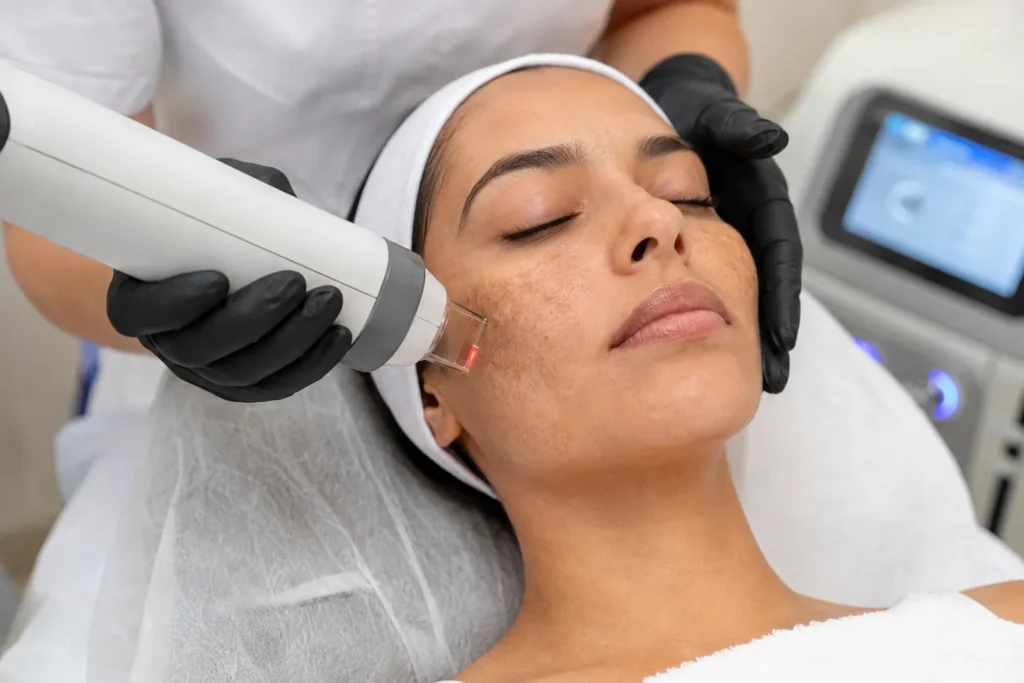
What Is Skin Pigmentation?
You may notice a few brown marks after acne, darker patches on your cheeks, or an uneven skin tone that wasn’t there before. Pigmentation Treatment in Andheri West can help address these concerns, but the first step is understanding why the pigment appeared.
Pigmentation refers to a change in skin colour caused by melanin, the pigment responsible for your natural skin tone. When the skin produces excess melanin in certain areas, those areas can look darker than the surrounding skin.
Pigmentation can appear on the face, forehead, cheeks, nose, upper lip, chin, neck, or other sun-exposed areas. It can also develop after acne, irritation, inflammation, hormonal changes, or certain skin treatments.
Not every dark patch is the same. A brown spot left behind after a pimple needs a different approach from melasma or sun-induced pigmentation.
That distinction matters because using the wrong cream or procedure can sometimes irritate the skin and make dark marks more noticeable.
Why Does Pigmentation Happen?
Pigmentation usually has more than one trigger. In many people, several factors work together.
Sun exposure
UV exposure is one of the most common reasons pigmentation becomes darker. Sunlight can stimulate melanocytes, the cells that produce melanin.
This is why pigmentation may look better during periods of strict sun protection and become darker after regular outdoor exposure.
Visible light can also worsen melasma and hyperpigmentation, particularly in darker skin tones. Tinted sunscreens containing iron oxides can provide additional protection against visible light.
Hormonal changes
Hormonal fluctuations can contribute to melasma. Pregnancy, some hormonal medications, and other hormonal changes may trigger or worsen facial pigmentation.
Melasma commonly appears as symmetrical brown or grey-brown patches on areas such as the cheeks, forehead, nose, and upper lip.
Acne and inflammation
Have you ever noticed a dark mark where a pimple used to be?
That may be post-inflammatory hyperpigmentation, or PIH.
It happens when inflammation stimulates excess pigment production. Picking, squeezing, or repeatedly irritating acne can increase the risk of lingering marks.
Skin irritation
Harsh scrubs, aggressive exfoliation, unsuitable skincare products, and repeated friction can irritate the skin.
Inflammation may then lead to darker patches, especially in people who are prone to pigmentation.
Certain medications or medical conditions
Some medicines and medical conditions can cause changes in skin pigmentation. Persistent or unusual pigmentation should therefore be assessed rather than treated blindly.
A dermatologist can help determine whether the pigmentation is melasma, post-inflammatory pigmentation, a sun-related spot, medication-related pigmentation, or another condition.
Common Types of Facial Pigmentation
Knowing the type of pigmentation is important because treatment depends on the cause, depth, location, and skin type.
Melasma
Melasma causes irregular brown or grey-brown patches, usually on both sides of the face.
It often affects the cheeks, forehead, nose, and upper lip. Sun exposure and hormonal factors can contribute to it.
Melasma can be stubborn and may return even after improvement. Dermatologists often combine sun protection with topical treatment and, when appropriate, procedures.
Post-inflammatory hyperpigmentation
This usually develops after inflammation.
Common triggers include:
- Acne
- Pimples
- Eczema
- Skin irritation
- Burns
- Inflammatory rashes
- Certain cosmetic procedures
The original skin problem may disappear while the darker mark remains.
Sun spots and solar lentigines
Repeated sun exposure can lead to persistent brown spots, especially on areas that receive regular sunlight.
These spots can occur on the face, hands, neck, and other exposed areas.
Acne marks
Not every acne mark is a scar.
A flat brown mark left after acne is often pigmentation rather than a true acne scar. Treating it is different from treating depressed or raised scars.
Pigmentation around the mouth
Darkness around the mouth can have several causes. Irritation, inflammation, hormonal factors, dryness, repeated rubbing, and post-inflammatory changes may all contribute.
It is better to identify the trigger before choosing a treatment.
What Causes Dark Spots and Uneven Skin Tone?
People often ask, “Why does my face look darker even though I use skincare?”
There can be several reasons.
You may be getting regular sun exposure without realizing it. Your sunscreen may not provide enough protection, or you may not reapply it when outdoors.
Another possibility is over-exfoliation. Using several acids, retinoids, scrubs, or strong active ingredients together can irritate the skin barrier.
Acne is another common factor. If breakouts continue, new pigmentation can keep appearing while older marks are still fading.
Stress and hormonal changes may also influence certain pigmentation conditions.
The important point is simple: treating existing pigmentation without controlling the trigger often leads to disappointing results.
How Is Pigmentation Diagnosed?
A proper assessment starts with looking closely at the skin and understanding your history.
A skin specialist may ask:
- When did the pigmentation start?
- Did it appear after acne or irritation?
- Does it become darker after sun exposure?
- Are the patches symmetrical?
- Have you recently changed skincare products?
- Are you using hormonal medication?
- Have you had previous chemical peels or laser procedures?
- Does the pigmentation come and go?
- What treatments have you already tried?
A dermatologist may also use magnification, a dermatoscope, or other examination methods to understand the pigmentation more clearly.
This is important because melasma, post-inflammatory pigmentation, sun spots, and other pigmentary disorders can look similar but may require different treatment plans.
Pigmentation Treatment in Andheri West: What Are the Options?
There isn’t one treatment that works for every pigmentation concern.
The right plan depends on the diagnosis, skin type, depth of pigmentation, sensitivity, previous treatments, and whether the trigger is still active.
1. Prescription and medical creams
Topical treatment is often an important part of managing pigmentation.
Depending on the condition, a dermatologist may recommend ingredients such as:
- Hydroquinone
- Azelaic acid
- Retinoids
- Kojic acid
- Vitamin C
- Tranexamic acid
- Other pigment-modulating ingredients
Some ingredients are prescription medicines and should not be used without professional guidance.
For melasma, dermatologists may use combinations of topical medicines along with strict sun protection.
2. Chemical peels
A chemical peel uses a carefully selected solution to exfoliate the outer layers of skin.
Different acids and concentrations may be used depending on the concern.
Peels can sometimes help with:
- Surface pigmentation
- Acne marks
- Uneven skin tone
- Dull-looking skin
- Mild sun damage
However, stronger isn’t always better.
If the peel causes excessive irritation, pigmentation can worsen. This is especially important for people who are prone to post-inflammatory hyperpigmentation.
3. Laser and light-based treatments
Certain laser or light-based procedures may be considered for selected pigmentation concerns.
The technology and settings must be chosen carefully. The wrong treatment or overly aggressive settings can cause inflammation and pigment changes.
Laser treatment isn’t automatically the “best” option simply because it is more advanced.
For melasma, laser and light treatments may sometimes be added to a broader treatment plan, but they require careful patient selection because recurrence and worsening pigmentation are possible.
4. Microneedling
Microneedling creates controlled microscopic channels in the skin.
It may be considered in selected cases, sometimes alongside topical treatment.
The procedure should be planned carefully because inflammation itself can trigger pigmentation in susceptible skin.
5. Medical facials and supportive skin treatments
Some patients may benefit from professionally selected skin treatments that support skin texture, hydration, and overall appearance.
However, a facial alone may not address the underlying cause of melasma or persistent hyperpigmentation.
A good treatment plan focuses on the condition first rather than simply making the skin look brighter temporarily.
Which Pigmentation Treatment Is Right for You?
This is one of the most common questions people ask before booking an appointment.
The answer depends on what type of pigmentation you have.
| Pigmentation concern | Common approach |
|---|---|
| Post-acne dark marks | Topical treatment, sun protection, selected peels or procedures |
| Melasma | Sun protection, topical medication, selected procedures |
| Sun spots | Topical treatment or selected laser/light procedures |
| Uneven skin tone | Skincare, sun protection, peels or supportive treatments |
| Pigmentation after irritation | Remove trigger, repair skin barrier, targeted treatment |
| Persistent or unusual pigmentation | Dermatological assessment first |
There is no universal “best pigmentation treatment.”
For example, a treatment that works well for a superficial sun spot may not be the right choice for melasma.
That is why a personalised assessment is more useful than choosing a procedure based only on before-and-after photographs.
Can Pigmentation Be Permanently Removed?
This depends on the cause.
Some forms of pigmentation can improve significantly with appropriate treatment and prevention. Others, especially melasma, can be chronic and may return when triggers such as sunlight or hormonal changes are present.
The goal should not always be “permanent removal.”
A more realistic goal is to reduce excess pigmentation, even out the skin tone, control triggers, and prevent recurrence.
The American Academy of Dermatology notes that melasma treatment can take several months, and results vary between individuals.
This is also why patience matters. Pigment doesn’t always disappear within a few days.
How Long Does Pigmentation Treatment Take?
There isn’t a fixed timeline.
Some fresh post-acne marks may gradually fade with proper skincare and sun protection. Deeper or long-standing pigmentation may take considerably longer.
Melasma can require ongoing maintenance.
Your response may depend on:
- Type of pigmentation
- How long you’ve had it
- Skin tone
- Depth of pigment
- Sun exposure
- Hormonal triggers
- Existing acne or inflammation
- Previous treatments
- Consistency with prescribed skincare
Dermatologists commonly set expectations over months rather than promising overnight results. For melasma, the AAD reports that treatment commonly takes around 3–12 months to show results.
Common Mistakes That Can Make Pigmentation Worse
Using too many active ingredients
More products don’t necessarily mean faster results.
Combining strong exfoliating acids, retinoids, scrubs, and brightening products without guidance may irritate the skin.
Skipping sunscreen
This is one of the biggest mistakes.
If sunlight continues to stimulate pigment production, even an effective treatment may struggle to deliver lasting improvement.
Picking acne
Squeezing pimples can increase inflammation and raise the chance of post-acne pigmentation.
Treating the acne itself is part of preventing new dark marks.
Trying random “fairness” creams
Some unregulated products may contain ingredients that aren’t suitable for long-term use.
If a product causes burning, redness, peeling, or worsening pigmentation, stop and seek professional advice.
Expecting one laser session to solve everything
Pigmentation isn’t always a surface problem.
A procedure may improve the appearance without controlling the underlying trigger. Recurrence can then occur.
Ignoring melasma triggers
If the pigmentation is melasma, treatment usually needs long-term sun protection and sometimes ongoing maintenance.
How to Prevent Pigmentation From Coming Back
Prevention is just as important as treatment.
Use sunscreen every day
Choose a broad-spectrum sunscreen with at least SPF 30. If pigmentation or melasma is a concern, a tinted sunscreen containing iron oxide may offer useful visible-light protection.
Reapply when needed, especially after sweating, swimming, or prolonged outdoor exposure.
Protect your face from direct sunlight
Sunscreen isn’t the only tool.
Use:
- Hats
- Sunglasses
- Shade
- Protective clothing
Try to reduce unnecessary direct sun exposure.
Keep your skincare gentle
If a product burns or stings, don’t assume that means it’s working.
Skin irritation can worsen pigmentation. Dermatologists recommend gentle, fragrance-free skincare for people managing melasma.
Control acne and inflammation
If new pimples keep appearing, new dark marks may continue forming.
Treating active acne can therefore be an important part of pigmentation management.
Don’t over-exfoliate
Exfoliation can be useful, but excessive exfoliation can damage the skin barrier.
A simple routine that your skin tolerates is usually better than a complicated routine that causes irritation.
Real-Life Example: Why Treating the Cause Matters
Imagine someone who develops brown marks after acne.
She starts using a strong exfoliating serum every night because she wants quick results. Her old marks don’t disappear, and her skin becomes irritated.
She then adds another brightening product.
The irritation increases.
At this stage, simply adding another pigmentation treatment isn’t necessarily the answer.
A better approach would be to control active acne, reduce irritation, restore the skin barrier, introduce suitable pigment-control ingredients, and maintain strict sun protection.
This example shows why pigmentation treatment isn’t simply about “removing colour.”
The cause matters.
When Should You See a Skin Specialist?
Consider professional evaluation if:
- Pigmentation keeps spreading
- Dark patches repeatedly return
- Pigmentation appears suddenly
- Over-the-counter products haven’t helped
- You have melasma-like patches
- Pigmentation developed after a cosmetic procedure
- Your skin burns or becomes irritated easily
- Dark spots are accompanied by other unusual skin changes
- You’re unsure whether a mark is acne pigmentation or a scar
A dermatologist can help identify the condition and create a treatment plan based on your skin rather than treating every dark mark in the same way.
Frequently Asked Questions
1. What is the best treatment for facial pigmentation?
There isn’t one treatment that works for everyone. The best option depends on whether the pigmentation is melasma, post-acne pigmentation, sun spots, or another condition. Treatment may involve topical medicines, chemical peels, laser or light-based procedures, microneedling, and strict sun protection.
2. Can pigmentation be completely removed?
Some pigmentation can fade significantly, but certain conditions such as melasma can recur. Long-term sun protection and maintenance treatment may be necessary.
3. How many sessions are needed for pigmentation treatment?
The number of sessions varies. It depends on the type and depth of pigmentation, treatment selected, skin response, and whether the underlying trigger is controlled.
A responsible clinic should assess your skin before recommending a fixed number of sessions.
4. Is laser treatment safe for pigmentation?
Laser treatment can be useful for selected pigmentary conditions, but it isn’t suitable for everyone. Incorrect settings or overly aggressive treatment may cause post-inflammatory pigmentation or other colour changes.
This is particularly important for darker Indian skin tones.
5. Can chemical peels remove pigmentation?
Chemical peels may improve some superficial pigmentation and uneven skin tone. The peel type and strength should be selected according to your skin and condition.
6. Why does pigmentation return after treatment?
Common reasons include continued sun exposure, hormonal triggers, ongoing acne or inflammation, skin irritation, and the natural tendency of conditions such as melasma to recur.
7. Does sunscreen really help with pigmentation?
Yes. Sun exposure can stimulate pigmentation and make existing dark patches darker. Daily broad-spectrum sunscreen is an important part of both treatment and prevention.
8. Is pigmentation around the mouth treatable?
It can be, but the cause needs to be identified first. Irritation, inflammation, hormonal factors, dryness, friction, and other conditions can contribute to pigmentation around the mouth.
9. Can acne marks and pigmentation be treated together?
Often, yes. But the treatment plan should address active acne as well as existing pigmentation. Otherwise, new marks can continue to develop.
10. How do I choose a pigmentation clinic in Andheri West?
Look for a clinic that offers professional skin assessment rather than recommending the same procedure to everyone.
Ask about the diagnosis, treatment options, expected results, possible side effects, number of sessions, aftercare, and maintenance plan.
Expert Tips for Managing Pigmentation
A few simple habits can make a meaningful difference.
Don’t chase instant results. Pigment develops over time and often takes time to improve.
Treat your skin gently. Burning and excessive peeling aren’t signs that a treatment is necessarily working.
Use sun protection consistently. This is one of the most important steps for preventing dark spots from becoming darker.
Don’t copy someone else’s skincare routine. Your friend’s pigmentation may have a completely different cause.
Be careful with home remedies. Lemon juice, baking soda, harsh scrubs, and similar DIY methods can irritate the skin and potentially worsen pigmentation.
Think beyond the procedure. A peel or laser session is only one part of a pigmentation plan. Skincare, sun protection, trigger control, and follow-up matter too.
Why Choose DERMACUTE AESTHETICS SKIN CLINIC?
Choosing a clinic for pigmentation isn’t only about finding the latest machine.
It is about getting the right diagnosis and a treatment plan that suits your skin.
Dr Vritika Agrawal is a dynamic Entrepreneur, investor and the Founder and CEO of DERMACUTE AESTHETICS SKIN CLINIC.
At DERMACUTE, pigmentation concerns can be assessed based on the type of pigmentation, skin condition, lifestyle factors, previous treatments, and individual goals.
The focus should be on realistic improvement rather than promising an overnight transformation.
If you’re comparing options for the Best Skin Care Clinic in Andheri, look for a clinic that explains both the benefits and limitations of treatment.
What to Do If Your Pigmentation Keeps Returning
Pigmentation can be frustrating, particularly when dark patches keep returning despite trying different products.
The good news is that many forms of hyperpigmentation can be managed with the right combination of diagnosis, skincare, professional treatment, and prevention.
The key is not to treat every brown mark in the same way.
Melasma, acne pigmentation, sun spots, and pigmentation caused by irritation have different triggers and may respond differently to treatment. Professional assessment can help determine the most suitable approach.
If you’re considering Pigmentation Treatment in Andheri West, start with an evaluation rather than choosing a procedure simply because it is popular.
Book a consultation for Pigmentation Treatment in Andheri West and get a personalised assessment based on your skin concern.